Wednesday, June 20, 2007

My Favorite Things

By Cornelia

1. & 2.


Window seats and toile de jouy curtains, respectively. No doubt a double-X chromosome thing.


3.


Heirloom tomatoes, and the way the plants smell when you're walking barefoot through warm humid garden dirt on a hot July afternoon to go pick some for dinner.

4.


This photograph of a magnolia blossom by Imogen Cunningham, because she makes it look like a temple.


This photo of Imogen herself, with model Twinka, taken by Judy Dater in 1981. Imogen is the one on the left.

5. & 6.


Patsy Cline, and


Hank Williams SENIOR.

Because some days you just need twangy yodeling.

7.


Robinson Jeffers' poetry--not least, these days:
Shine, Perishing Republic

While this America settles in the mould of its vulgarity, heavily thickening to empire
And protest, only a bubble in the molten mass, pops and sighs out, and the mass hardens,
I sadly smiling remember that the flower fades to make fruit, the fruit rots to make earth.
Out of the mother; and through the spring exultances, ripeness and decadence; and home to the mother.

You making haste haste on decay: not blameworthy; life is good, be it stubbornly long or suddenly
A mortal splendor: meteors are not needed less than mountains: shine, perishing republic.
But for my children, I would have them keep their distance from the thickening center; corruption
Never has been compulsory, when the cities lie at the monster's feet there are left the mountains.
And boys, be in nothing so moderate as in love of man, a clever servant, insufferable master.
There is the trap that catches noblest spirits, that caught--they say--God, when he walked on earth.


1924


8.
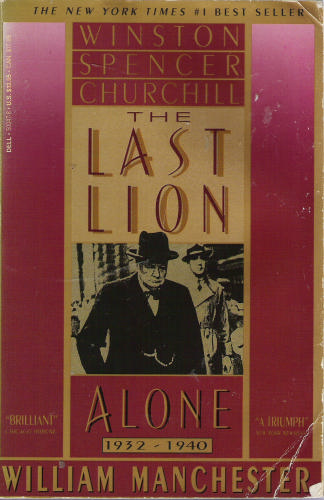


William Manchester's magnificent biography of Winston Churchill, which for me stands as one of the acmes of non-fiction writing, both for its flights of oratory:

England's new leader, were he to prevail, would have to stand for everything England's decent, civilized Establishment had rejected.... Like Adolf Hitler he would have to be a leader of intuitive genius, a born demagogue in the original sense of the word, a believer in the supremacy of his race and his national destiny, an artist who knew how to gather the blazing light of history into his prism and then distort it to his ends, an embodiment of inflexible resolution who could impose his will and his imagination on his people -- a great tragedian who understood the appeal of martyrdom and could tell his followers the worst, hurling it to them like great hunks of bleeding meat, persuading them that the year of Dunkirk would be one in which it was "equally good to live or to die" -- who could if necessary be just as cruel, just as cunning, and just as ruthless as Hitler but who could win victories without enslaving populations, or preaching supernaturalism, or foisting off myths of his infallibility, or destroying, or even warping, the libertarian institutions he had sworn to preserve. Such a man, if he existed, would be England's last chance.

In London there was such a man.
And for his ability to capture Churchill's wit:

He called Atlee "a sheep in sheep's clothing," and "a modest man with much to be modest about," and he drove a sharp needle into Labour policy one day when he met him in the House's men's room. Attlee, arriving first, had stepped up to the urinal trough when Churchill strode in on the same mission, glanced at him, and stood at the trough as far away from him as possible. Attlee said, "Feeling standoffish today, are we, Winston?" Churchill said: "That's right. Every time you see something big, you want to nationalize it."

9.

Josephine's bed at Malmaison, because sometimes humanity requires a profound and absolute respite from all things IKEA, even though I think dusting is a massive pain in the butt and plus you'd probably have to have those sheets drycleaned every damn week or whatever. (See #1).

10.


Holland and Holland shotguns.


I mean, how could you not love such an object?

11.


"Cher Guevara," and whoever invented her.

12.


Hanging out on the beach in Bali with an Aussie named Tony Ruwald who my sister Freya met while surfing there, in 1988.

13.


The view from Nepenthe, in Big Sur, home of the "Ambrosia Burger."


Although I miss the old days, when they still had canvas director's chairs scattered around the terrace, instead of plastic.

14.


Old VW single cab trucks. Just because.

15.


Being able to make a Southpark self-portrait.

How about you guys? What's your fave thing du jour?

Tuesday, June 19, 2007

Readers Speak; We Listen and Learn

From Paul

A reader took me to task yesterday. Don, from Virginia Beach, VA, writes:
I just finished "Trial & Error," and, like all your books I've read, enjoyed it. I wonder, though, why you thought it appropriate to insult a portion of your customers by calling people that buy Rush Limbaugh's book a derogatory name? It seemed so out of place since nowhere else do you take a shot at anyone else's political beliefs. Do you hate Rush so much that you're willing to insult a portion of your customers just for the satisfaction of taking a shot at him?

Here's what Don is complaining about. Just before going into the courthouse to begin voir dire, shady lawyer Steve Solomon peeks into car windows in the Jurors' Parking Lot. He tells the reader why:
People leave clues about themselves everywhere, including their car seats.

A wad of traffic tickets. Defense juror.

"Guns and Ammo" magazine. Prosecution juror.

A book by Rush Limbaugh. Simple-minded juror.

So, Don, it was a joke. Not a very good joke, it's true. And now, on reflection, I think it was a cheap shot. Condescending and unfair. It's fine to mock Rush Limbaugh for his simplistic, misleading, and often outrageously false statements. But his readers and listeners should be permitted to draw their own conclusions without being slammed, even in jest.

Next, Andrew, a lawyer in Dallas, writes about a scene in "Trial & Error," where Steve Solomon tears the murder indictment in half and tosses it at the prosecutor, proclaiming it's nothing but a worthless piece of paper.

I had a DWI trial in Fort Worth this past Monday. After the prosecution read the "information" (complaint in Texas for a misdemeanor), I grabbed it as I approached the jury box during opening, and I referred to it as simply a piece of paper and "flung" it back at the Prosecutor's table. Needless to say, I got a Not Guilty verdict in conservative-ass Fort Worth after 20 minutes of deliberation. You the man!!! Keep them books coming.

Way to go, Andrew. Texas lawyers are ballsy, I'll say that. You could have been held in contempt...as Steve Solomon frequently is.

Finally, Richard in Detroit writes, after reading "Solomon vs. Lord":

As the father of a genius-but-mildly-autistic
child (Asperger's Syndrome) I thought the character of Bobby,
the nephew, was right-on-target and much appreciated.

Thank you, Richard. I've heard from many parents and teachers of autistic children. The best, most heartwarming letters I could ever receive.

Recently, a reader suggested a sub-plot involving Bobby that was better than the idea I was working on. As writers, our characters are real to us. To our best readers, they're just as real. I'd like to encourage my fellow Naked Authors to share their mail.

************************************************
OKAY, AGENT BORN. YOU WANT PICTURES. YOU GOT PICTURES.


Jim Born, that pesky provocateur, has been taunting me. Last week, I posted goofy photos of Arnold Schwarzenegger and Phil Spector from the 1970's. So Jim challenged me to post some vintage photos of my own naked scribbling self.

I generally do what Jim says, if only because he is heavily armed. (Donna says Jim comes to bed "locked and loaded," whatever that means). So, I'm posting some photos from Memory Lane, potholes and all. Perhaps Jim will reciprocate, starting with photos of those wild parties at Florida State.

Paul, wearing lapels as wide as radial tires, and moot court partner Dan Schwartz display their modest National Moot Court Championship trophy. (New York 1971)

Your Naked Scribbler, with an excess of hair, white bell-bottoms, and a purple nylon Nik-Nik shirt. (Helsinki 1974).


Penn State Quarterback (and current CBS broadcaster) Todd Blackledge with your Naked Nittany Lion, wearing a blue velour warm-up suit of the sort favored by Paulie Walnuts. (New Orleans, New Years Day 1983)

Son Michael is surprised to learn on his second birthday that Naked Dad expects him to attend Penn State if he wants his tuition paid. Quick at math, Michael complies. (Coral Gables, 1983)

Paul windsurfs on the ocean in a twenty-knot breeze, making Naked Lake Windsurfer Jim Born insanely jealous. (Aruba 1985)


Following Hurricane Andrew, your Naked Sweeper clears rubbish at ex-spouse Alice's house. (Coral Gables, 1992)

Although your Naked Scrivener and Elmore Leonard share the same fiction prize, Mr. Leonard politely rejects Mr. Levine's creative idea that they pool their royalties and split them 50-50. (Tampa 1994)

After writing four books in 27 months, your Exhausted Scribbler is sent to a "rest home." (Rancho Cucamonga 2007)

Paul

Monday, June 18, 2007

Cynthia Joyce Russell Dickson

Patty here…

Two upcoming events have prompted me to write this post: Cindy’s birthday was last week, June 12th and my third book will be released on July 3rd. For reasons that you will soon learn, Cindy and my book releases are forever intertwined.

I met Cindy Dickson on a film set in the early eighties. We had both come to Los Angeles to seek our fortunes, me via Seattle, she via Australia then London then New York then Las Vegas then Alaska. She was Australian but her accent was British. She told me the teachers in the Episcopal school she attended had schooled the Aussie accent out of her.

She had had many exotic adventures—some told, some only hinted at—which imbued her with an aura of mystery. She was a consummate story teller, and I loved to listen to her lilting voice relate tales of growing up on a sheep station in the outback, traveling from Sydney to London on a tramp steamer, acting on the stage in Melbourne, hosting a talk show on Australian TV, writing newspaper columns for papers in Fairbanks and Sitka. After she came to L.A. she turned her attention to writing screenplays and poetry. She also started working on a novel, a stream of consciousness piece that was a metaphor for a life filled with joy and betrayal.

Cindy and I stumbled through the eighties together and much of the nineties, sharing adventures, a lot of Happy Hour hors d’oervres, and a great many laughs. At some point in the nineties our two roads diverged, as Robert Frost would say. We each took separate paths and drifted apart for a while. One day I picked up the telephone and called her. It was as if we hadn’t talked for days not years.

In around 2001 or so Cindy moved to Marin County in Northern California. Shortly after that she began to call me every week on the same day. It was unlike her. Cindy was a free spirit who never kept to a schedule. She told me it was because she had all those free minutes on her cell phone and wanted to take advantage of them, but I sensed some darker truth. She seemed unhappy, lonely, depressed. Ill? A melancholy overtook her and I began to worry. I sent her a guardian angel pin and told her it would protect her until she could return to Los Angeles where she belonged.

Cindy did come back to Southern California but not to L.A. She said she wanted a more tranquil setting, a slower pace, so she settled in Ventura, a beach town about sixty miles north of here. She was an original and people loved her for it. She joined a poetry group and made many new friends. One September morning in 2003, I received a telephone call from her. It was 7:00 A.M. I was still in bed.

“I’m on my way to the doctor,” she said. “I have breast cancer. I just wanted you to know.”

I was stunned but managed to babble a few words like What? How? The “why” would come later.

I drove to Ventura as often as I could after that. I sat by her bedside during chemotherapy. I walked down the hospital hallway beside her gurney on the day of her mastectomy, stopping only when forced to at the swinging doors of the surgery room. Post surgery I spooned ice into her mouth to quench her thirst.

Despite two massive chemo regimes and enough radiation to nuke a small 3rd world county, the cancer continued to spread throughout her body. The doctor proposed one last-ditch effort to save her life, a third trial of chemo.

In the end it was the pain that controlled her decision. Cindy simply could no longer face that pain or the chemo brain or the debilitating illness. She opted for hospice care at a nursing home instead. Afterward, she questioned her decision but declined to amend it. She got angry for a time, but I never once saw her display a hint of self-pity. She was stoic, never once mentioning the words death or dying. Once during one of our many conversations I mentioned something about the many phases we had gone through in our lives. She responded wryly, “Yes, but I’m not looking forward to this next phase in mine.”

Cindy knew the time would come when she could no longer make decisions about her life or her death, so she asked me to be her Durable Power of Attorney. It was an honor to have her trust, but also a heavy responsibility. She was concerned about dying alone, so I promised her I would never let that happen. The social worker assigned to her case told me that when Cindy was near the end I could come to stay with her in the empty bed in her room. I was frantic. “How will I know? How will I know?” I kept asking her. “You’ll know,” was all she said.

Neither Cindy nor I knew how long she had, so in the next three months we talked a lot. I asked if I could put some of her old photographs in an album. At first she said no but later she relented. When the album was finished, I think she enjoyed showing it to the many friends who came to visit her as well as to the hospice staff. During this period she passed along the guardian angel pin (that I’d given her to her when she lived in Marin) to her friend Doris who promised to pass it along to someone else when the time was right.

Ventura is more than an hour from Los Angeles. On the days I couldn’t visit I called her on the telephone, sometimes more than once a day. November arrived and although Cindy was frail and weak, her spirit was strong and her pain under control. My first book was due to be released on November 22. She was proud of me. She asked me to read it to her, but her concentration was waning and after a few paragraphs she would stop me to ask a question or to reminisce about some past adventure she wanted to share with me.

On Sunday, November 21, I held a launch party for my first book, False Profits. Cindy had been fine the day before, but on Sunday she wasn’t fine at all. I knew when I spoke to her on the telephone that she had turned a dark corner. By the time I got to Ventura that day, her speech was garbled. Still, she was desperately trying to tell me something. Our inability to communicate verbally was agonizing for both of us.

“I’m sorry,” I said to her, “I want so much to know what you’re saying, but I can’t understand you. I just want you to know, I’m here and I love you.”

I kept repeating that last phrase, over and over. Her “I love you, too,” were the only words I could understand.

I sat by her bedside all night, holding her hand, reassuring her I was there, that I wasn’t going to leave, that I loved her. She died at 2:00 a.m. the following morning. It was November 22, 2004, the official release date of my book.

Cindy wanted her ashes scattered in a “lovely garden” somewhere. I haven’t found that place yet, but I will some day. I think I’ve been waiting, thinking that perhaps I would take her back to Australia, find her sister and her brother with whom she had lost touch. I’d tell them about her life and how much she was loved by so many people, including me. I’d show them the photo album. Tell them about the tramp steamer and the poetry. It’s the amateur sleuth in me that yearns to find them.

Cindy had a brother named William John George Thomas Russell, Jr. who may be living in New Zealand and sister named Jean Russell, married name unknown, who may be living near Blackall, Queensland, Australian. Her mother’s name was Catherine Sophia Rose Anderson. Google has turned up nothing. Her friends didn't even know she had siblings. If you can help or know somebody who can, please press the envelope icon below and forward this post.


And to Cindy—I will miss you always...

Friday, June 15, 2007

A Whale of a Century

from Jacqueline

Don’t know if you saw the news item this week, about a whale caught up in Alaska, that had embedded in its shoulder bone an arrowhead fragment, part of the type of harpoon used back in the late 1800’s. This meant that the whale, a bowhead, was well over 100 years old and might well have been pursued by whaler of the type commanded by good old Captain Ahab. I thought it was sad, really, that the whale had managed to get by for a century, and yesteryear’s harpoon head was found when they were using chain saws to cut up the leviathan. I know the Eskimo feed on this whale, and that traditionally they use every part of the animal, but there was something so sad about that whale’s ending, as if he deserved to go on and on until nature took care of his end. I feel like that about most animals, particularly whales, though I am glad I can count on veterinary science to help me out with my domestic animals.


The idea of living through a century, especially the last century, just boggles the mind. It was only a couple of years ago that the man who had led the last cavalry charge by an American mounted army, passed away, in Menlo Park, I think, or somewhere like that, in an area that is now known for its tech industry. Cavalry charges and iPods, just a couple of degrees of separation.


Years ago, the author Howard Spring wrote a novel about a woman who lived one hundred years. He said he wanted to write such a story, just to explore history’s passing in the life of one person. I thought about that a lot – I think I must have been in my teens when I read the book, and I wondered about my own life. Can’t say as I think living to 100 would be all beer and skittles, what with researchers now saying the oil will begin to seriously run out in four years time. Solar power is looking very, very attractive, and thank heavens I can drive a horse and cart.

I’m only just over the half-century, and the changes I’ve seen astonish me, at times. As a child only one person owned a telephone in the hamlet where I lived, and that was the shopkeeper at the end of the road. We also had a telephone kiosk, but if your relations needed to get hold of you in an emergency, then they called the shop and Fred Cooke would send one of his kids down to your house to give you the message. And because we didn’t have a car, we couldn’t go anywhere until the London coach went through the next day, if we had to go to London in a hurry, because that’s where all our family lived. The "coach" by the way, was just a bus, but because the service had started in the days of horse-drawn transport, people still called it the coach. I thought about those times yesterday, when I announced to my husband that I thought I might like an iPhone, entranced by the idea of having my entire media world in an almost paper-thin do-dad at my fingertips – which was a surprise, really, because I am not what you’d ever call an “early adopter.” All a bit different from Fred Cooke’s black bakelite telephone.


I worked on the local farms as a child – the big advantage of being a country kid, you could always get outdoor work throughout the school breaks – and one day while gathering spent hop bines, I found a pin from the uniform of a First World War Land Army girl. I had that pin for years, and even used to wear it. I was crushed when it dropped off on the London tube one day. I love the idea of being in this world and having some connection to the past, some memory that gives me only a degree of separation or two from history.


I wonder how much that whale had needed to compensate for our oceans becoming more polluted, and warmer. Had he changed his territorial habits, or had he thought, “I’m too old for that!” There he was, a whale who had been born at the time of the sailing ship, and lived long enough to see his kin deafened by the navy’s sonar. And ever since I read that story yesterday, I’ve wished he was the one who got away.


Now, on another note, you may recall that a few times over the past year, I’ve asked that question, “How do I raise the bar on myself?” The question has mainly been in connection with who I am as a writer, but as we writers know, everything about who we are is part of being a writer, otherwise people wouldn’t write or read blogs. I flirted briefly with the idea of doing an MFA in writing, however, I kept coming back, in my deliberations, to a course I had been fascinated by for about ten years that, essentially, delves into what it is to be human, through the lens of mythology and depth psychology. The MA/PhD program in Mythology and Depth Psychology at the Pacifica Graduate Institute in California, is the sort of thing I would have loved to do when I was younger, but not only do I think you need a few miles on you before you open a lid like that, but someone would have said, “You’ll never get a job with that for a degree!”


I finally bit the bullet in early April, having already attended two open days and several of their short courses, and spoken to numerous ex-students (many of whom are writers) – and sent in my application. I knew I could handle my studies along with my writing - the fact that it’s low residency and not far from where I live helps – and hoped that one would inspire the other. People come from all over the world to this particular seat of learning, which also houses the Joseph Campbell library, so I wasn’t overly confident when it came to assessing my chances. My interview was scheduled for just a few days after I sustained my shoulder injury, and I decided to go ahead with it, but not take the painkillers, otherwise I might have been way too interesting – to myself, anyway. And at the end of last week I heard that I had been accepted. So, in September, I will be going back to school. I’m more than a little scared, but that particular emotion is outweighed by excitement, and I’m happy to report that a significant number of the students are of the “mature” variety. I’ll keep you posted!

Have a good weekend one and all, and if you want to share this post, you can use the envelope icon below.

Thursday, June 14, 2007

Father's day is no joke!

Who are your influences?

I may have written about this before, frankly, I can’t remember. I get asked about my influences all the time.

Like many writers, I’m influenced by a host of other authors. Notably, as the phtos show, Elmore leonard and W.E.B. Griffin. But I’ve realized that I’m influenced in all aspects of my life and wonder if others have the same experience.

Do you sometimes say something and realize you adopted the comment from someone else? I’m not talking about a short story or plot, I mean in real life. The non-fiction book we live every day.

Like many men, I’ve found that my dad’s comments and even his mannerisms have taken hold in me. It may have taken a while but I find my attitude is extremely similar to my father’s even though our backgrounds are very different.

My father was raised during the depression in the 1920s and 1930s in Pittsburg. He was in the army in the Pacific during world war II, or as he called it, the big war. He came home and attended the University of Miami, then went through the UM law school and settled in West Palm Beach. He was also 39 by the time I came along. And big. He was not unusually tall at 5’11” but with wide shoulders and a weight that fluctuated between 235 and 240, he was “Big John” to a lot of people.


As you can see here he is in his army uniform and sitting with the lovely Jane Wickerham, who he married and I knew as my mother.

I was raised in the comfort of West Palm Beach, Florida. I didn’t even see snow until I was seventeen when it snowed in South Florida. I was not in the military and have never actually viewed the Japanese as a threat. I attended Florida State, and, at my father’s insistence, did not attend law school, opting instead for the wildly lucrative degree of a master degree in psychology with a minor in statistics.

Despite the differences, I find that everything my father held dear, I do too. Most the attitudes my father held toward others I find I hold them too. It didn’t happen over night. But, son-of-a-gun if he wasn’t right about everything.

He believed people did what they had to do. It was a way of saying people were good but occasionally did bad things. When I first started in police work I thought this notion was absurd. Now, in most cases, I can see where people make choices that are available to them. Sometimes choices were removed from them at a young age. Maybe a lack of education, an abusive family or mental condition. I’m not excusing criminal behavior but I’ve learned through experience that people often commit crimes for reasons other than the obvious.

My dad believed more work got done in the hallways of courthouses than in the courtroom. I’ve found that informal talks often lead to quicker solutions to serious problems more than organized negotiations. Administration is the anchor on civilization.

My father worked hard every day. He believed that hard work and a friendly attitude would make life more tolerable. For a guy who lived in a tent on Guam wondering if the Japanese would rule the Pacific with an iron fist, lived when no one in the country had a job and saw snow since his first year, he had one hell of a good attitude. I believe his attitude was infectious. People liked his company. I liked his company. Even as a teenager I liked to hang out with my dad.


My dad passed away more than 17 years ago but he influences me and, indirectly, my children, more than he'll ever know.

In publishing, it’s easy to get down on yourself or blame others. I guess those kind of thoughts are easy in any job. What’s hard is being happy and a good attitude is important. If you had to live on Pacific island, dodge bullets and disease, raise kids in a hectic, crazy time and still have a positive outlook you’d influence others too.

Who are your influences?

Wednesday, June 13, 2007

Tea. Earl Grey. Hot.

By Cornelia

I have long been fascinated by antique visions of the future--images and ideas about what life would be like some decades hence, that so often reveal more about one's present than the true outcome of temporally distant events. They are so often better at recording a contemporary sense of style and art direction than they are at revealing any true prescience, not least about fashion.

I love the deco sensibilities of what space-age life was imagined as in the Thirties, from appropriate rocket wear:


To the rockets themselves:


I love the Sixties conception of futuristic architecture, via the New York World's Fair:


I remember reading in my mother's high school year book some 1957 senior's imaginings about the class's 25th reunion to be, which would be held at the school's newly completed lunar campus:


I love the gadgets everyone expected we'd have in our future lives, a la the Jetsons, not least the personal Jet Pack:


And the ubiquitous space-cars that sped along glassy highways on cushions of air:


And the machines that would produce any favorite item of food by some alchemical recombination of molecules, ending world hunger in an atomic flash:


Captain Jean-Luc Picard from Star Trek: Next Generation is famous for having always ordered, "Tea. Earl Grey. Hot."

There are some visions which are better left unremembered, however, especially those from the Seventies:


Many of which seem to have come to aesthetic fruition in certain cities' subway stations:


Can anyone walk through Atlanta's MARTA or some of D.C.'s train stops without thinking of Logan's Run?

Or visit some architectural outposts of Denver without thinking of Woody Allen's Sleeper?


And then, of course, there are the computers:


Both real and imagined. When you look at those pictured below, can you remember how impossible it would have been to imagine, say, Youtube, only twenty years ago?


Even Kubrick thought the computers of the future would take up the amount of space necessary for a small metropolitan museum:


How bizarre that this morning, I can create for free from the safety of my desk a virtual television, in this online journal, which shows HAL speaking and singing in French:


As Dave turns him off, he begins to sing not "Bicycle Built for Two," But "Claire de Lune."

I still really really really want my own Jet Pack, and having a replicator sure wouldn't suck, especially when I realize I forgot to buy the essential ingredient for the evening's dinner.

What future gadget did you most want, as a kid?

Tuesday, June 12, 2007

Macho Senate Dems Spank Forgetful Al

By Paul

The Democrats are peeved that Alberto Gonzalez cannot recall who fired a slew of U.S. Attorneys and apparently also forget where he hid the key to the executive washroom. Yesterday, the Senate could only muster 53 votes (out of 60 needed) to tell the Attorney General that's he's a stinkeroo as head of the so-called Justice Department. But unknown to the mainstream media, the macho Senate Democrats unilaterally took action against the famed Bush messenger boy. ("Would somebody please wake up John Ashcroft? Or at least, pull out his tubes!")

In a righteous hissy fit, the Democratic majority placed Gonzalez on double secret probation.


NON-STORY OF THE DAY: FOX NEWS PIMPS FOR BUSH

As if we didn't know...

The Project for Excellence in Journalism reports that Fox News spends only half the time covering the disastrous war in Iraq as MSNBC and other cable news networks.

Here's a shot you WON'T see on Fox.


Here's a shot you WILL see on Fox.

Which, I ask our Naked Readers, is uglier?

As anyone who has watched television the last week can attest, Fox and the other cable networks have given substantially more time to the Paris Hilton saga than the war in Iraq. Which brings us to...

STOP THE PRESSES: Paris Hilton Finds God in Jail


After a weekend of hard time in the slammer, Paris Hilton has had a spiritual awakening. Yesterday, in a collect phone call, she told Barbara Walters: "God released me." (Even if the judge didn't). "My spirit or soul didn't like the way I was being seen."

Note that Ms. Hilton didn't say that God was unhappy with her actions, only the way those actions were perceived. Ah, but I nitpick.

Now, the young misdemeanant desires to do her full term. That hasn't stopped her cretinous admirers from begging Gov. Schwarzenegger to pardon Paris. They'll also sell you a "Free Paris" bracelet for 10 bucks. Not that it matters, but the website gets it wrong. Ms. Hilton was not jailed for "DUI," but rather for a violation of probation by driving (repeatedly) with a suspended license. At any rate, here's the preamble of the on-line petition:

To:
The Honorable Governor Arnold Schwarzenegger

Paris Whitney Hilton is an American celebrity and socialite....She provides hope for young people all over the U.S. and the world. She provides beauty and excitement to (most of) our otherwise mundane lives.

Pardon moi. But my mundane life is about to hurl chunks.

We here at Naked Scribblers are sworn not to publish any photos of Ms. Hilton, with or without underwear. Therefore, we are forced to illustrate this story with a photo of our esteemed governor. First, an oldie...


And, more recently...


Yes, time is cruel. Let's put this in perspective. In the same era that our Governor-to-be was ingesting enough steroids to kill a herd of buffalo, bizarro record producer Phil Spector (now on trial for murder) was going through his urban cowboy phase.


And, more recently...


A question for our female readers. Would you go home from a club with this man at 3 a.m., knowing he'd consumed about 15 alcoholic beverages that evening and his "castle" was filled with loaded firearms (19 or 20) and at least one jumbo bottle of Viagra?

Paul